

Scientists Are Workers — and It’s Time We Organize
By Amanda Rabinowitz Ph.D.
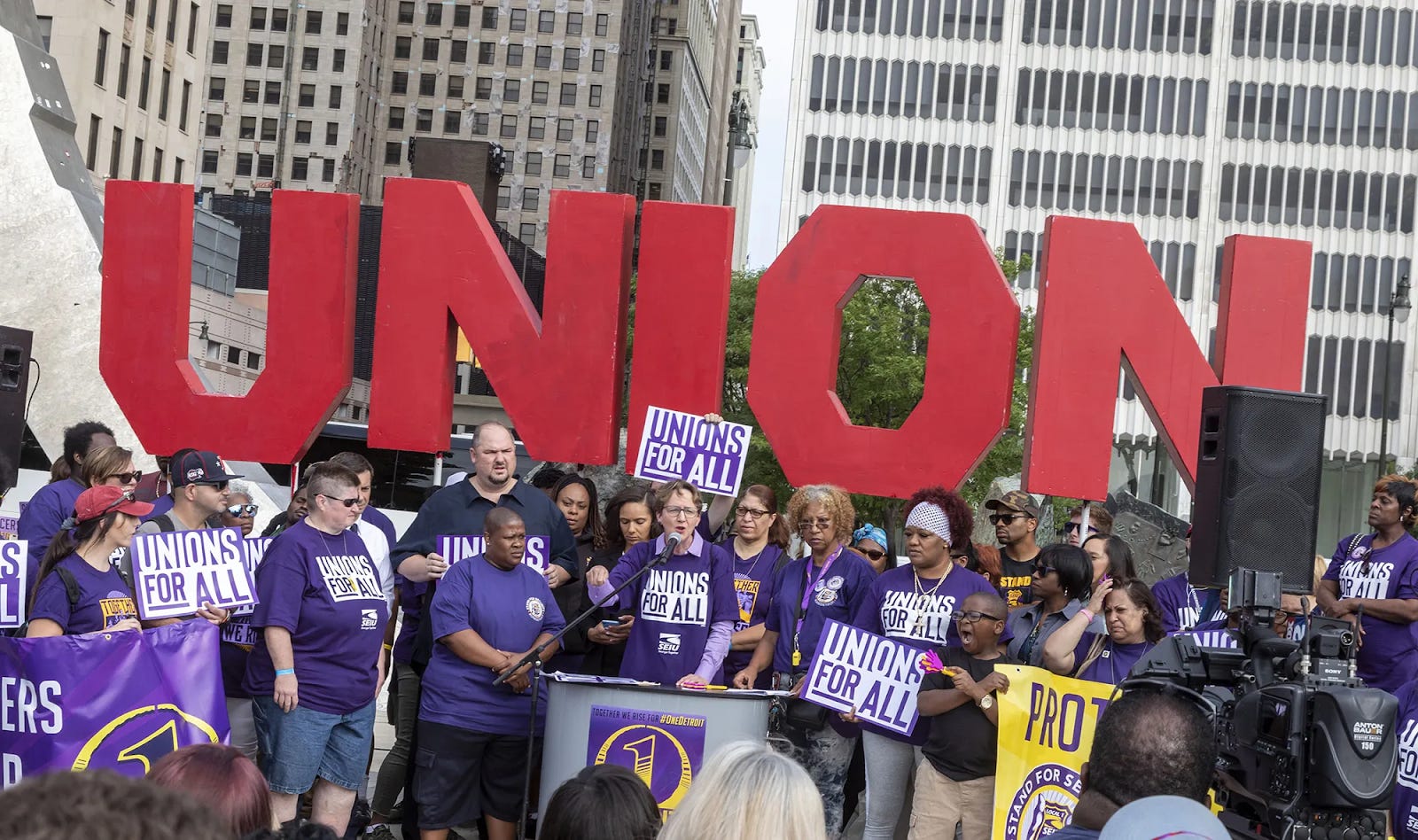
As we have documented on this Substack, the Trump administration has launched a full-on assault on science.
This isn’t rhetorical overreach. We’ve seen systematic attacks on federal research agencies, ideological interference in public health and climate science, the gutting of advisory committees, the intimidation of civil servants, and the chilling of speech through funding threats and loyalty tests. Scientific independence — the idea that evidence, expertise, and peer review should guide research and policy — has been treated as an obstacle rather than a public good.
What’s at stake is not just the integrity of scientific knowledge today, but the future of the scientific workforce itself. Training pipelines are already fragile. Careers are increasingly precarious. If these attacks succeed, rebuilding won’t be as simple as “going back to normal.” The future of science depends on how well we fight back now — and whether we can imagine and build something stronger on the other side.
Individual Scientists Can’t Fight This Alone
As individual actors, scientists are not positioned to stand up to a coordinated federal assault. A single principal investigator, postdoc, or program officer has very little leverage against an administration willing to weaponize funding, appointments, and regulation.
But collectively, scientists have power.
That power doesn’t primarily come from prestige, publication counts, or institutional branding. It comes from organization — from acting together through collectives, interest groups, and especially unions that can exert real pressure on employers, boards, and government agencies.
Many scientists have understandably looked first to our institutions for protection: universities, research hospitals, professional societies, and scientific organizations. In theory, these should be bulwarks against political interference.
In practice, the results have been mixed at best.
Some universities refused to sign onto the administration’s “Compact for American Excellence in Higher Education,” which undermines diversity, equity, and academic freedom. Others — including major research institutions like Vanderbilt and the University of Texas — declined to publicly denounce it. More troubling still, faculty at universities in Texas and Indiana have faced discipline for expressing views disfavored by the Trump administration, a blatant violation of academic freedom.
The lesson is uncomfortable but clear: we cannot rely on our institutions to save us.
Look at Who Runs Our Institutions
If you want to understand why universities fold under political pressure, look at who actually governs them.
Boards of trustees are overwhelmingly populated by bankers, venture capitalists, private equity executives, and corporate leaders. Their primary expertise is not the pursuit of knowledge or the defense of intellectual freedom — it is risk management, donor relations, and alignment with power.
Here in Philadelphia, the University of Pennsylvania offers a telling example. Marc Rowan, a billionaire private equity executive, is chair of Wharton’s board of advisors and a major donor. In 2023, he led a donor campaign that successfully pushed out Penn’s president and board chair over what he deemed an insufficient response to campus speech related to Palestine. Following the Palestine Writes conference, Rowan attempted to organize donor boycotts and demanded sweeping campus “reforms” that faculty described as a “hostile Republican takeover” threatening intellectual freedom.
This is not an aberration. It’s how power works inside elite universities.
When political pressure mounts, boards respond not as guardians of academic freedom, but as corporate governance bodies protecting brand, donors, and influence. Expecting them to consistently defend science against an authoritarian administration is wishful thinking.
Professional Societies Issue Statements. Unions File Lawsuits.
Professional organizations can — and often do — issue strong statements in defense of science. These matter symbolically. But when it comes to actual resistance — legal challenges, injunctions, material consequences — it is unions that are leading the way.
A review of lawsuits filed against the Trump administration shows that labor unions are among the most consistent and effective challengers. They have standing. They have resources. And critically, they are accountable to members rather than donors or political appointees.
Meanwhile, where is industry?
Biotechnology is clearly under attack, yet industry leaders have signaled a willingness to partner with the administration so long as profits are protected. As Joseph Grogan recently argued, biotech should align itself with the administration’s agenda — even offering financial support — in exchange for influence over research priorities. Workers are notably absent from this vision.
Industry will pursue its interests. We shouldn’t expect otherwise. But we also shouldn’t confuse those interests with the defense of science or scientific workers.
Scientists Are Workers — Not Bosses
Many of us, especially in academia, are encouraged to think of ourselves as independent actors — “our own bosses,” guided by curiosity and the pursuit of knowledge. This self-image is deeply ingrained, and deeply misleading.
Scientists are workers.
Our value comes from our labor and the products of that labor: knowledge, data, innovation, education, care. We work under conditions set by others — funding agencies, university administrators, hospital systems, corporate employers. Those conditions determine not just what research gets done, but who gets to stay in the field at all.
When scientists recognize common cause with other science workers — lab technicians, graduate students, postdocs, adjuncts, grants administrators, librarians, data managers — we can form collectives capable of exerting real pressure. Together, we can influence wages, job security, workload, speech protections, and the ethical conditions under which science is produced.
There’s a concept librarians have named “vocational awe” — the idea that devotion to a higher calling is used to justify low pay, long hours, and poor working conditions. Scientists are just as susceptible. We are told that passion should substitute for stability, that sacrifice is the price of meaning.
It doesn’t have to be.
The Good News: Organizing Is Growing
Despite everything, there is good news. Union density in higher education is increasing — even as unionization has declined across the U.S. workforce overall.
According to the National Center for the Study of Collective Bargaining in Higher Education, faculty unionization has grown steadily since 2012. About 27% of faculty are now union members — more than double the national average for workers overall. The majority of new faculty unions represent non-tenure-track and contingent faculty, those most exposed to precarity.
Graduate student employee unionization has surged even faster. As of 2024, nearly 38% of graduate student workers belong to unions — a 133% increase since 2012. Undergraduate workers are organizing too, from dining hall staff to resident advisers to college athletes.
Even flagship scientific journals are acknowledging this reality. In May 2025, Nature Reviews Physics published an editorial bluntly titled: “Scientists are workers.”1
This shift matters. It reflects a growing recognition that the future of science depends not just on funding levels or presidential administrations, but on whether the people who actually do the work have power.
Defending Science Means Defending Scientists
If we want to defend science against authoritarianism, we must stop treating scientists as exceptional individuals floating above politics and labor relations. We are part of the working class — highly skilled, deeply trained, but workers nonetheless.
Institutions will hedge. Industry will compromise. Administrations will come and go.
But organized workers endure.
Here in Philadelphia and beyond, scientists have a choice: continue to hope that someone else will protect us, or recognize our collective power and use it. Organizing is not a distraction from science. It is how we defend the conditions that make science possible. Start by using the Find My Union Guide and get involved.
References
Scientists are workers. Nat Rev Phys 7, 231 (2025). https://doi-org.proxy.library.upenn.edu/10.1038/s42254-025-00832-6
Find My Union Guide
For Academic Workers (Grad Students, Postdocs, Faculty, Research Staff)
United Auto Workers (UAW) — A major union representing graduate workers, postdocs, research staff, and faculty at many universities.
🔗 https://uaw.org/American Federation of Teachers (AFT) — Represents faculty and academic professionals; includes resources linked with AAUP.
🔗 https://www.aft.org/American Association of University Professors (AAUP) — A union and professional association focused on faculty rights, academic freedom, and collective bargaining.
🔗 https://www.aaup.org/Office and Professional Employees International Union (OPEIU) — Represents professionals in a range of workplaces, including technical and research roles.
🔗 https://www.opeiu.org/United Electrical, Radio and Machine Workers of America (UE) — A democratic union organizing across sectors including academic, research, and technical workers.
🔗 https://www.ueunion.org/
For Federal Scientists and Government Researchers
American Federation of Government Employees (AFGE) — The largest union representing federal employees, including scientists and researchers across federal agencies.
🔗 https://www.afge.org/National Treasury Employees Union (NTEU) — Represents many federal workers and can include scientists at agencies like the FDA, EPA, and NOAA.
🔗 https://www.nteu.org/
For Other Scientists & Science Workers
Many scientists work alongside other categories of professional employees, and these unions also organize science-support roles in universities, hospitals, biotech, and research settings:
Service Employees International Union (SEIU) — A large union that organizes technical, research support, healthcare, and university staff.
🔗 https://www.seiu.org/
General Healthcare Worker Unions
These unions represent a broad range of healthcare workers — from clinicians to allied professionals and support staff:
National Union of Healthcare Workers (NUHW) — A member-driven union focused on quality patient care and worker rights for nurses, allied health professionals, and support staff.
🔗 https://nuhw.org/International Federation of Professional and Technical Engineers (IFPTE) — Healthcare Division — Organizes healthcare professionals including RNs, pharmacists, therapists, radiologic technologists, and others.
🔗 https://www.joinifpte.org/healthcareUNAC/UHCP (United Nurses Associations of California/Union of Health Care Professionals) — Represents more than 40,000 healthcare professionals in California and Hawaii, negotiating for fair wages, staffing, and benefits.
🔗 https://unacuhcp.org/
Unions Specifically for Nurses & Allied Professionals
While some of these are nurse-focused, many welcome allied health professions as well:
Health Professionals and Allied Employees (HPAE) — Represents registered nurses and other healthcare workers in hospitals, nursing homes, clinics, and research facilities, including in the Philadelphia/NJ region.
🔗 https://www.hpae.org/United Nurses and Allied Professionals (UNAP) — A New England union for nurses, technologists, therapists, and allied healthcare staff.
🔗 https://www.unap.org/National Nurses United (NNU) — The largest U.S. nursing union, advocating for safe staffing, fair pay, and stronger healthcare systems.
🔗 https://www.nationalnursesunited.org/
Physician & Trainee Unions
These represent physicians in training (and in some cases practicing clinicians):
Committee of Interns and Residents (CIR/SEIU Healthcare) — The largest union of resident physicians, fellows, and house staff, affiliated with SEIU.
🔗 https://www.cirseiu.org/Union of American Physicians and Dentists (UAPD) — A historic union for physicians and dentists focused on worker rights and improved patient care.
🔗 https://www.uapd.com/ (official site; historical info from wiki)
Tips for Exploring Your Eligibility
Check with your institution’s HR or labor relations office to see if a bargaining unit already exists.
If your workplace isn’t unionized yet, many of the unions above offer organizing support to start a campaign.
Unions are organized by workplace and employer, not by academic discipline — so even within science fields like biology, physics, engineering, psychology, or data science, eligibility depends on how you’re employed.
About the author:
Dr. Amanda Rabinowitz is a brain injury neuropsychologist and member of the leadership team at Philadelphia Science Action.
This articulates something critical that many in academia overlook: the false comfort of institutional protection. The case study of Penn and Marc Rowan is particularly instructive—it demonstrates how donor influence can override academic freedom faster than any external political pressure. The comparison between professional societies issuing statements versus unions filing lawsuits gets to the heart of power asymmetries. When you examine who actually has leverage to challenge coordinated attacks on science, organized labor consistently shows up with material resources and legal standing. The vocational awe concept resonates strongly here too. There's a cultural expectation in science that passion should compensate for precarity, which leaves researchers vulnerable exactly when collective action matters most.